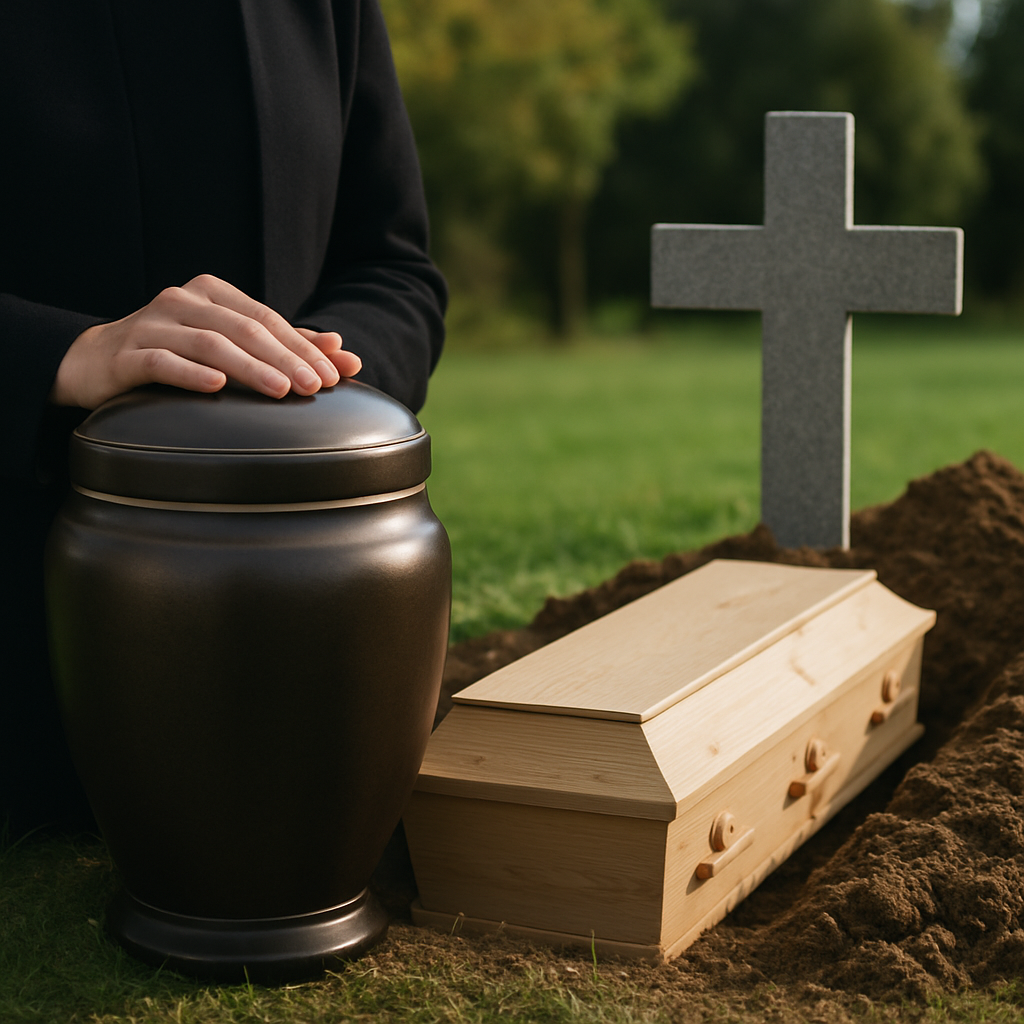
Choosing between cremation and burial is deeply personal—but it’s also practical. In the last decade, U.S. preferences have shifted rapidly: cremation is now the majority choice and is projected to keep rising. Families cite cost, environmental impact, religious considerations, and flexibility of memorial options as their top decision factors. This guide pulls together recent data, government and academic research, and expert views so you can decide what’s “better” for you—financially, ethically, and spiritually. According to the National Funeral Directors Association (NFDA), the U.S. cremation rate is projected at 61.9% in 2024, with burial at 33.2%, and cremation is expected to reach roughly 82% by 2045 (NFDA, 2024; NFDA, 2023).
Recent headlines also show a fast-evolving landscape: Maryland authorized “water cremation” (alkaline hydrolysis) and providers there have begun offering it, reflecting demand for gentler, greener options. Meanwhile, multiple states are debating human composting (natural organic reduction) as another low-carbon choice (Washington Post, Aug. 18, 2025; WHYY, Sept. 2, 2025).
Key Takeaway
- Cost: Cremation with a service typically costs less than a funeral with burial (cemetery costs extra either way). See national medians below (NFDA, 2023).
- Environment: No single method is best in every metric; studies generally find green/natural burial has the smallest footprint, while traditional burial and flame cremation carry different impacts (land use vs. emissions). Electric or water cremation can reduce emissions (HHC Earth LCA, 2024).
- Faith & Culture: Some religions require burial (e.g., Islam; many strands of Judaism) while others permit cremation with conditions (e.g., Catholic Church) (ICRC, 2025; Vatican CDF, 2016; My Jewish Learning, overview).
- Flexibility: Cremation allows varied memorial timing and locations; burial can offer a permanent place of remembrance (NFDA trend reports above).
1) Costs in 2025: What Families Actually Pay
National medians (NFDA 2023 GPL Study): Funeral with viewing and burial: $8,300 (median), not including plot, marker, or cemetery fees; adding a vault brings the total to about $9,995. Funeral with viewing and cremation: $6,280 (median). These medians include specific line items (basic services, transfer, embalming/prep, metal casket for burial or alternative container and urn for cremation, facility/staff, hearse/service car, memorial package) but exclude cemetery costs and cash advances (NFDA, Dec. 8, 2023).
What this means: Even before cemetery charges, a burial funeral typically costs about $2,000–$3,700 more than a cremation funeral. Cemetery fees vary widely by location and can add thousands (plots, opening/closing, vaults/liners often required by cemeteries). Providers estimate grave liners at $700–$1,000 and vaults at $900–$7,000+ (Dignity Memorial explainer, 2025).
Your rights on pricing: Under the FTC’s Funeral Rule, you’re entitled to an itemized General Price List (GPL) on request and can buy only the services and goods you want. Updates are under consideration to improve online price transparency (FTC Consumer Advice; ITIF analysis, 2023).
2) Environmental Impact: Emissions vs. Land Use (and Why Studies Differ)
Researchers use life-cycle assessment (LCA) to compare options. A 2024 comparative LCA reported climate-change contributions (kg CO2e per person) roughly as: gas cremation ~181, burial (stone monument) ~120, resomation (water cremation) ~118, electric cremation ~45, and natural burial ~40—but noted tradeoffs like land-use impact for natural burial (HHC Earth / DELA LCA, Aug. 12, 2024).
Earlier work by Keijzer and colleagues similarly found that funeral impacts vary by assumptions (e.g., coffin materials, grave maintenance, travel to services) and that no single method wins every impact category. Some estimates for a single flame cremation range from ~160–210 kg CO2 (efficient facilities) to ~388 kg CO2 in certain scenarios—illustrating why ranges are reported rather than a single “true” number (Keijzer et al., 2017; C&EN explainer, 2019; Cremation Association of North America, briefing).
Other emissions: The U.S. EPA estimates ~2.3 tons of mercury emitted in 2020 from human cremation (primarily from dental amalgam). Local totals are small compared with power plants but are non-zero and have prompted controls in some jurisdictions (EPA NEI Technical Support Document, 2023).
Burial & groundwater: Peer-reviewed studies show mixed results. Some cemetery sites show little detectable contamination; others raise concerns about heavy metals and formaldehyde in specific conditions (soil type, hydrogeology, burial density). A 2025 Minnesota state report reviewed evidence and cited work finding cemetery-adjacent wells with parameters below detectable limits in one long-term study, while other studies document potential risks (Minnesota Green Burial & NOR Study, Jan. 31, 2025; Richardson et al., 2024; Ponce Arguello et al., 2024).
Bottom line on environment
- Green/natural burial (no embalming, biodegradable shroud/casket, no vault) often scores best in LCAs for climate impact, with tradeoffs in land use (Applied Soil Ecology, 2024; HHC Earth, 2024).
- Flame cremation uses fossil fuel and emits CO2 and trace pollutants; electric cremation (paired with clean grids) and water cremation (alkaline hydrolysis) can lower emissions (HHC Earth LCA, 2024; NFDA Alkaline Hydrolysis explainer).
- Traditional burial avoids smokestack emissions but uses materials (caskets, vaults) and land indefinitely, and can entail mowing/fertilization depending on cemetery practices (NFDA, 2023; Applied Soil Ecology, 2024).
3) Health & Workplace Safety Considerations
Embalming chemicals: Formaldehyde—commonly used in embalming—is classified as a human carcinogen by the International Agency for Research on Cancer (IARC) and is regulated for occupational exposure by U.S. agencies. NIOSH and OSHA publish controls and guidance to protect embalmers and prep-room staff (American Cancer Society (citing IARC), 2024; NIOSH Engineering Controls; OSHA hazard page).
Public health & cremation: Combustion emissions include particulate matter and hazardous air pollutants; amalgam-related mercury is a focus of EPA emission inventories and local permitting (EPA NEI TSD, 2023; Piagno et al., 2020).
4) Faith & Cultural Perspectives
Catholic Church: Cremation is permitted but the Church prefers burial; ashes should be kept in a sacred place (not scattered or kept at home), with guidance laid out in the 2016 instruction Ad resurgendum cum Christo (Vatican CDF, 2016).
Islam: Cremation is generally prohibited; burial is required as a matter of dignity and religious law (ICRC law & policy blog, June 19, 2025).
Judaism: Orthodox and Conservative authorities prohibit cremation; Reform responsa discourage it but permit individual choice (My Jewish Learning, overview; CCAR (Reform) responsum).
5) New & Emerging Options (2024–2025)
Water cremation (alkaline hydrolysis): This method uses water, heat, and alkali to accelerate natural decomposition; bones are processed to “ashes,” and the sterile liquid is typically discharged per wastewater permits. States continue to legalize it, and 2024–2025 saw active adoption and local zoning debates (e.g., Maryland) (Washington Post, 2025; NFDA explainer).
Human composting (Natural Organic Reduction): Legal in a growing list of states (first approved in Washington in 2019), with additional states considering bills in 2025 (e.g., New Jersey) (US-Funerals.com, May 16, 2025; Philadelphia Inquirer, July 31, 2025).
6) Generational Preferences & Ceremony Trends
Surveys suggest younger Americans aren’t universally “pro-cremation”. One 2024 NFDA survey discussed by Axios reported Gen Z showing more interest in traditional burial than Baby Boomers, who are more likely to prefer cremation. Viewing the body remains important across many younger respondents (Axios, Oct. 29, 2024).
7) Practical Framework: How to Decide What’s “Better” for You
Budget & Location
- Price reality check: Ask for GPLs from multiple providers; verify what’s included; remember cemetery costs (plot, opening/closing, marker, vault/liner) are extra for burial and can also apply to cremation if you choose inurnment (FTC Funeral Rule; NFDA, 2023).
- Direct options: “Direct cremation” (no ceremony at funeral home) and “direct burial” lower costs substantially but trade off formal services (see local GPLs; rights under the Funeral Rule: FTC).
Environmental Priorities
- If your top goal is lowest carbon impact, consider green/natural burial or providers offering electric cremation or water cremation where legal (HHC Earth LCA, 2024; Applied Soil Ecology, 2024).
- If you value a permanent place of remembrance without ongoing lawn care inputs, look for conservation or natural burial cemeteries (evidence points to potential biodiversity and soil benefits when managed as native habitat: Applied Soil Ecology, 2024).
Religious & Cultural Needs
- Confirm practices with your clergy or community. Islam and many Jewish authorities require or strongly favor burial; Catholic teaching permits cremation with conditions on handling ashes (see: ICRC, 2025; My Jewish Learning; CCAR; Vatican CDF).
Health & Transparency
- If embalming is not required by law for your situation, ask about non-embalming options (refrigeration, dry ice) or low-tox alternatives. (Occupational hazard literature flags formaldehyde exposure as a risk for workers: American Cancer Society; NIOSH.)
8) Data Visualization Opportunities
- Cost comparison (2023 medians): $8,300 burial (no cemetery) vs. $6,280 cremation; vault adds ~$1,695. Suggested chart: Bar chart. Source: NFDA, 2023.
- Cremation vs. burial rates over time: 61.9% cremation projected in 2024; ~82% by 2045. Suggested chart: Line chart. Sources: NFDA, 2024; NFDA, 2023.
- Environmental footprint ranges: kg CO2e per method (green burial, electric cremation, water cremation, flame cremation, traditional burial), with caveats. Suggested chart: Stacked bars. Sources: HHC Earth, 2024; C&EN, 2019.
So…Is Cremation or Burial “Better”?
There isn’t a universal winner. If cost and scheduling flexibility matter most, cremation (especially direct cremation plus a personalized memorial later) often makes sense. If your faith requires it—or if you want a permanent gravesite—burial may be best. If your priority is environmental impact, look for green/natural burial or lower-emission innovations (electric or water cremation) where available; both trends are expanding in 2024–2025 (NFDA; Washington Post; US-Funerals.com).
FAQs (Long-Tail Questions Answered)
How much cheaper is cremation than burial?
NFDA medians show ~$6,280 (cremation with viewing) vs. $8,300 (burial with viewing) before cemetery fees; vaults and plots can push burial costs near or above $10,000 (NFDA, 2023).
Which option is best for the environment?
LCAs often favor green/natural burial (no embalming, no vault, biodegradable container) for climate impact; water cremation and electric cremation can also perform well. Results vary by electricity mix, cemetery practices, and family choices (e.g., travel) (HHC Earth, 2024; Applied Soil Ecology, 2024; C&EN).
Does my religion allow cremation?
Islam prohibits cremation; Orthodox/Conservative Judaism prohibit it; Reform Judaism discourages but permits; Catholicism permits cremation with guidance for handling ashes (e.g., not scattering or keeping at home; see pastoral notes). Always consult your faith leader (ICRC, 2025; My Jewish Learning; CCAR; Vatican CDF).
Is embalming required?
Often no; laws vary by state and situation (e.g., time between death and disposition, public viewing). Ask your provider about refrigeration or other alternatives. For worker safety and health context, see NIOSH/OSHA resources on formaldehyde (NIOSH; OSHA).
Where is water cremation or human composting legal?
Coverage is expanding by state; Maryland providers began offering water cremation in 2024–2025, and multiple states are moving composting bills in 2025 (e.g., New Jersey). Check current state trackers or your local funeral home (Washington Post, 2025; US-Funerals.com, 2025).
Conclusion: A Values-First Decision, Informed by Good Data
“Better” depends on your priorities. If you want affordability and flexibility, cremation (possibly direct cremation plus a personal memorial later) will likely meet your needs. If religious law or a lasting gravesite is paramount, burial may be right. If you’re motivated by sustainability, consider green/natural burial or, where available, lower-emission methods like water or electric cremation. Whatever you choose, exercise your FTC Funeral Rule rights: compare GPLs, ask what’s included, and align the plan with your values and budget (FTC)